
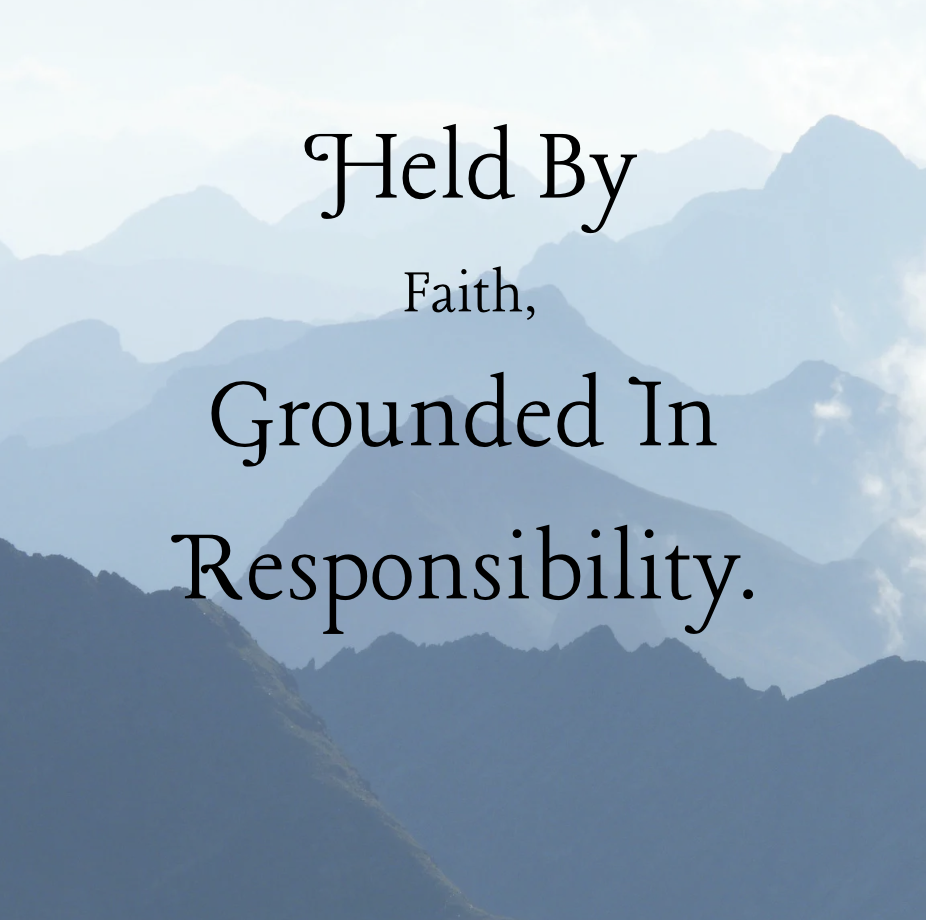
Faith and Accountability: Learning to Hold Both at Once
Faith can be a powerful anchor. It gives meaning to uncertainty, offers comfort in difficult seasons, and reminds us that we are not navigating life alone. In many ways, it softens the sharp edges of life, giving us language for hope when circumstances feel overwhelming. But when faith is misunderstood or misapplied, it can quietly drift into something else entirely—avoidance, denial, or even the outsourcing of personal responsibility. What begins as trust can slowly become passivity if we’re not paying attention. So how do we hold onto faith while also staying grounded in accountability?
At its core, faith invites trust. It asks us to believe in something beyond what we can immediately see or control. Accountability, on the other hand, asks us to take ownership—of our actions, our choices, and their impact on ourselves and others. These two ideas are not opposites. In fact, they work best when they are in conversation with each other, creating a balance that is both steady and growth-oriented.
1. Surrender vs. Participation
One common tension shows up in the idea of “letting go and letting God” (or a higher power). While surrender can be deeply healing, it can also become a way to disengage from necessary effort. Letting go is not the same as checking out. Faith is not meant to replace action—it’s meant to guide it. Trusting the process does not remove our role in participating in it. We still have to show up, make decisions, repair harm, and grow.
Surrender, when practiced in a healthy way, is less about giving up control entirely and more about releasing the illusion that we ever had full control to begin with. It creates space for peace, but it should not come at the cost of responsibility. Growth still requires movement. Even with faith, we are asked to engage with our lives, not step away from them.
2. Reflection as a Spiritual Practice
Faith traditions often encourage introspection, humility, and personal growth. Accountability brings those values into real-world practice. It moves reflection from a passive thought process into an active tool for change. It asks questions like: What part did I play in this? What can I do differently? How have my actions affected others?
These questions are not always comfortable, but they are necessary. Without them, faith risks becoming performative rather than transformative—something we say we believe without allowing it to shape how we live. True reflection requires honesty, and honesty requires courage. It asks us to sit with ourselves without defensiveness and without immediately shifting blame outward.
When faith and reflection work together, they create a space where growth feels possible rather than punishing. Instead of seeing mistakes as failures, they become invitations to learn and realign.
3. Grace and Responsibility Can Coexist
Faith often emphasizes forgiveness—both receiving it and extending it. Grace offers relief from shame and reminds us that we are not defined solely by our worst moments. But forgiveness without accountability can feel incomplete, especially in relationships. Words alone rarely repair what actions have broken.
True repair involves acknowledging harm, taking responsibility, and making meaningful changes. It requires consistency, not just intention. Grace doesn’t erase responsibility; it creates space for it to be handled with compassion rather than harsh self-condemnation.
This balance matters because without grace, accountability can feel overwhelming and lead to avoidance. Without accountability, grace can become enabling. Together, they create a pathway forward—one that allows for both honesty and healing.
4. Avoiding Spiritual Bypassing
Sometimes, spiritual language is used to sidestep emotional work. Phrases like “just pray about it” or “everything happens for a reason” can unintentionally shut down deeper exploration. While often well-intentioned, these responses can dismiss real feelings or minimize complex situations.
This is often referred to as spiritual bypassing—the use of faith-based ideas to avoid dealing with uncomfortable emotions, conflict, or responsibility. It can look like avoiding hard conversations, dismissing pain too quickly, or skipping over the process of healing in favor of quick reassurance.
Accountability invites us to stay present in those moments. It asks us to listen more deeply, to communicate more honestly, and to engage even when it’s uncomfortable. Faith can still be present in these spaces, but it becomes a support rather than an escape route. It sits beside the discomfort instead of trying to erase it.
5. Faith Doesn’t Cancel Personal Agency
Faith can be empowering. It can remind us that we are supported, guided, and not alone in our experiences. But accountability ensures we don’t lose sight of our own agency in the process. Our choices still matter. Our actions still have consequences.
We are not passive participants in our lives—we are active contributors. Faith does not mean waiting for change to happen without effort. It means trusting while also taking steps forward. It means recognizing that while we may not control everything, we are still responsible for how we respond.
Belief and action are meant to move together, not compete for control. When they are aligned, they create a sense of direction that feels both grounded and hopeful.
Ultimately, the goal isn’t perfection. It’s alignment. When faith and accountability are balanced, they create a steady rhythm: trust and action, grace and responsibility, surrender and effort. Together, they allow for growth that is both grounded and expansive.
So perhaps the question isn’t whether to choose faith or accountability—but how to practice both more intentionally. Where might faith be guiding you forward? And where is accountability asking you to step up?
Written By Sophie M. Limbourg