
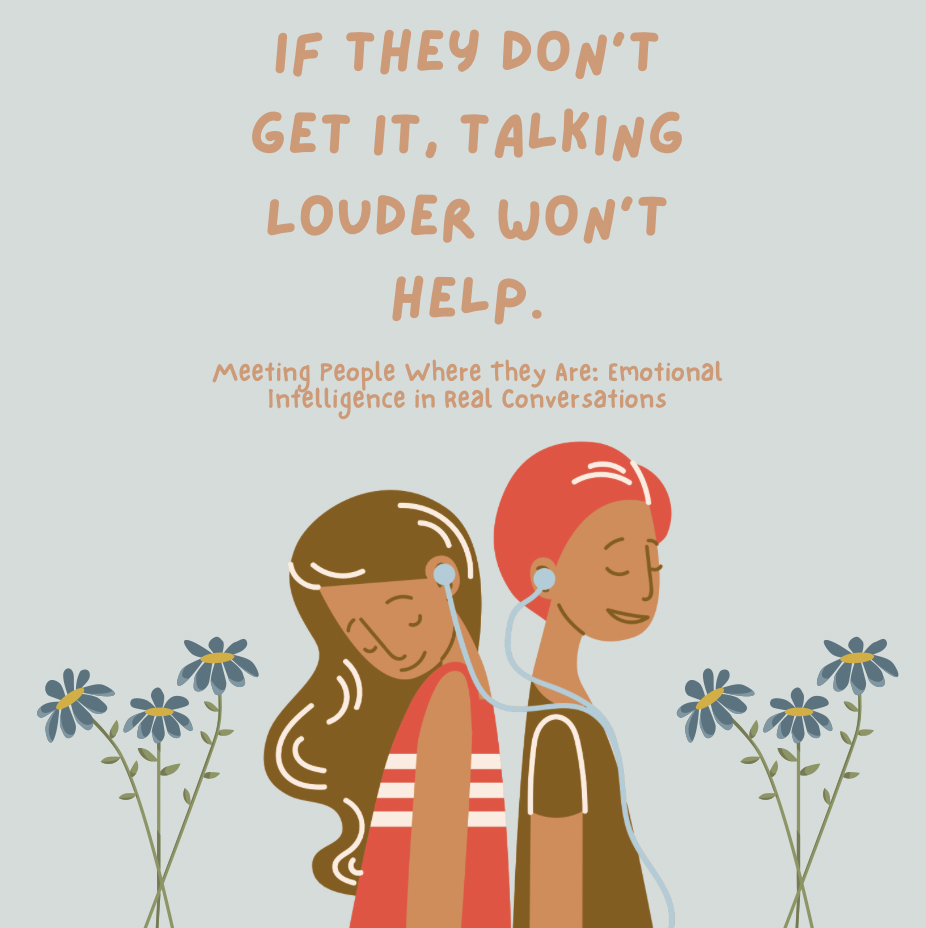
Meeting People Where They Are: Emotional Intelligence in Real Conversations
In therapy and in everyday relationships, we often talk about emotional intelligence as if it were a universal skill set that everyone experiences the same way. But in reality, emotional intelligence exists on a spectrum. People differ in how they process emotions, interpret situations, and make meaning out of their experiences. One of the most important relational skills is learning how to meet people where they are emotionally, rather than expecting them to understand the world through the same lens we do.
Two Sides of The Same Coin:
Sometimes communication breaks down not because someone is unwilling to understand, but because two people are processing the same situation through completely different emotional frameworks.
For example, someone with strong discernment and analytical awareness may approach a problem by identifying patterns, contradictions, or underlying motivations. They may see the dynamics of a situation clearly and want to point out what feels obvious to them. However, when that message is delivered to someone who leads primarily with empathy, the response may not be clarity. Instead, the empathetic person may focus on feelings, relationships, or intentions rather than the analytical interpretation of the situation.
Both perspectives hold value. The challenge arises when one person assumes their interpretation is the only “correct” way to see what happened.
When communication comes across as corrective, dismissive, or superior, even unintentionally, the other person may feel misunderstood or spoken down to. At that point, the conversation shifts from understanding the issue to defending one’s perspective. The result is often disconnection rather than clarity.
A key part of emotional intelligence is recognizing that people do not experience the same event in the same way. Two people can look at the same situation and walk away with very different truths. That doesn’t necessarily mean one person is right and the other is wrong. It means each person is interpreting the experience through their own history, emotional wiring, and worldview.
It’s Not You It’s Us:
When we take the time to understand how someone else arrived at their perspective, something important happens. The conversation becomes less about proving a point and more about building understanding. This doesn’t require abandoning your own viewpoint. Instead, it involves curiosity about the other person’s internal process.
For example:
- An analytical person may need to slow down and acknowledge emotions first before explaining their reasoning.
- A highly empathetic person may benefit from hearing the logic behind someone’s interpretation without feeling that their emotional experience is being invalidated.
Meeting someone where they are emotionally does not mean agreeing with everything they say. It means recognizing the starting point of their understanding and communicating in a way that connects with that starting point.
This approach often requires patience and humility. It asks us to pause before correcting, explaining, or persuading. It invites us to ask questions like:
- What does this situation look like from their perspective?
- What emotional needs are shaping how they see this?
- How can I communicate my thoughts without dismissing their experience?
When people feel understood first, they are far more open to hearing another perspective.
Healthy communication is not about winning a debate or proving someone wrong. It is about creating enough psychological safety for two perspectives to exist in the same conversation. From there, clarity and connection have a chance to grow.
At its core, emotional intelligence is not just about understanding our own emotions. It is about recognizing that everyone is navigating the world with a different emotional map. The more we learn to meet people at their point on that map, the stronger and more meaningful our relationships become.
Written By Sophie M. Limbourg