
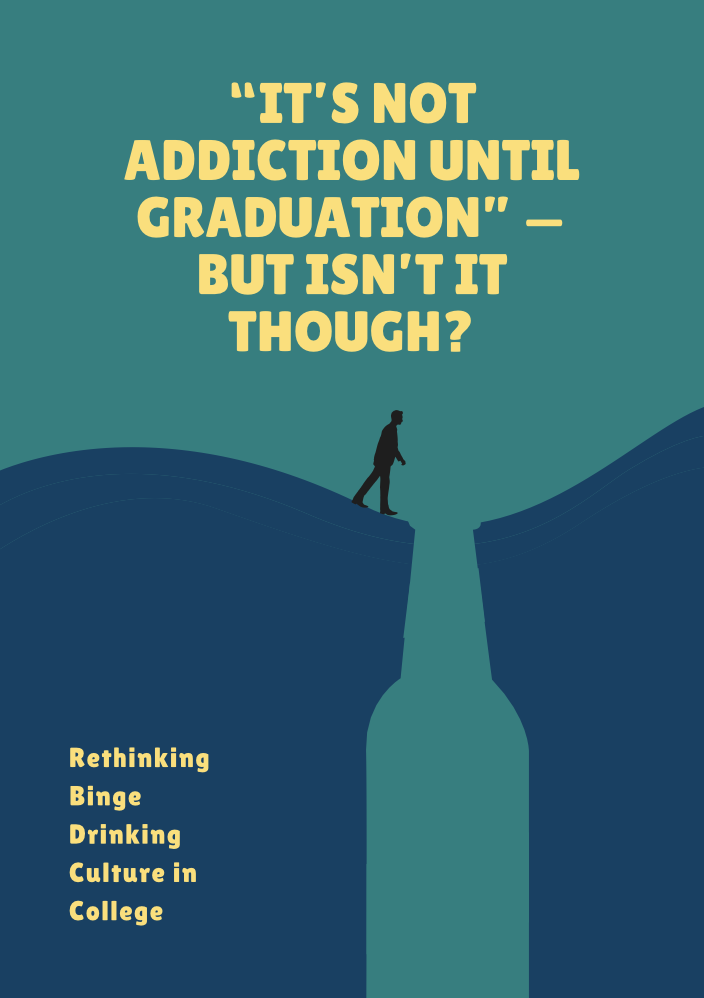
Rethinking Binge Drinking Culture in College
Living in active addiction does not suddenly become healthy or casual consumption the moment someone is handed a diploma.
I felt compelled to write this after seeing the young woman currently going viral on TikTok — the so-called “50 Day Bender Girl” — documenting herself getting drunk every day for the 50 days leading up to graduation in an effort to “make the most of it.”
What struck me wasn’t just the drinking itself. It was the reaction to it.
Thousands of people expressed concern and horror, while thousands more cheered it on. Laughing. Relating to it. Calling it “classic college memories.” Repeating phrases many students know all too well:
“You only live once.”
“It’s not addiction until graduation.”
And honestly, that phrase says far more about college drinking culture than people realize.
When Excess Becomes Tradition
College has long been associated with partying, experimentation, and excess. For many students, binge drinking is framed almost as a rite of passage — something expected, normalized, and even celebrated.
Heavy drinking becomes woven into:
- tailgates,
- birthdays,
- Greek life,
- weekends,
- finals relief,
- breakups,
- celebrations,
- and sometimes simply boredom.
The message students often absorb is:
This is what college is supposed to look like.
But somewhere along the way, we stop asking an important question:
When does “having fun” stop feeling like a choice?
The Problem With Extremes
Conversations about alcohol tend to swing between extremes.
On one side:
- “Everyone drinks in college.”
- “Relax, it’s normal.”
- “You’re young — enjoy it.”
On the other:
- “Just stop drinking.”
- “Get sober.”
- “Alcohol ruins lives.”
The truth is far more nuanced than either side usually admits.
For many young adults, simply telling them “don’t drink” is about as effective as teaching abstinence-only sex education. It ignores reality, curiosity, social pressure, and basic human behavior.
Most college students are not going to become permanently sober because someone lectured them online.
But that doesn’t mean the conversation ends there.
The Goal Should Be Awareness
What we can encourage is awareness.
Awareness asks different questions:
- Why am I drinking tonight?
- Am I celebrating, connecting, coping, escaping, or numbing?
- Do I actually want to be here?
- Is this still fun for me, or does it simply feel expected?
- How does drinking affect my mood, relationships, anxiety, sleep, or self-respect afterward?
College is often the first time young adults experience complete freedom without much structure. Part of growing up is learning not only how to have fun, but also how to recognize your own limits.
And those limits look different for everyone.
Learning the Difference Between Celebration and Self-Destruction
There is nothing inherently wrong with wanting to celebrate, let loose, or create unforgettable memories with friends. Some of the most meaningful moments in college come from joy, spontaneity, and connection.
But there is also wisdom in learning:
- when drinking enhances an experience,
- and when it quietly begins replacing emotional coping skills.
There is a difference between:
- partying occasionally,
- and feeling unable to enjoy yourself without being intoxicated.
There is a difference between:
- celebrating graduation,
- and needing alcohol every day leading up to it just to get through the experience.
Sometimes binge drinking is not really about fun at all. Sometimes it is stress. Loneliness. Anxiety. Pressure. Identity confusion. Fear of the future. Fear of slowing down long enough to feel uncomfortable emotions.
And college students deserve compassionate conversations about that — not shame, and not blind encouragement either.
You Don’t Have to Hit Rock Bottom to Check In With Yourself
One of the most harmful myths around alcohol is the idea that concern only matters once someone’s life completely falls apart.
But self-awareness can happen long before addiction does.
You can ask yourself:
- Do I like who I become when I drink?
- Am I making choices I feel okay about afterward?
- Is alcohol helping me connect, or disconnect?
- Can I still have a good time without it?
- Am I drinking because I want to, or because I feel like I’m supposed to?
Those questions are not judgmental.
They are healthy.
A More Compassionate Conversation
The answer is not moral panic.
The answer is not pretending college drinking culture doesn’t exist.
And the answer is probably not telling every 20-year-old they need lifelong sobriety.
The healthier conversation is one rooted in honesty, self-awareness, and emotional education.
Young adults deserve space to learn:
- how to recognize unhealthy patterns,
- how to care for themselves socially and emotionally,
- how to set boundaries,
- and how to recognize when “fun” is starting to cost too much.
At a time when increasing numbers of young people are entering recovery before they are even legally old enough to drink, trends like “50 Day Bender Girl” reveal something deeper than internet humor. They reveal how polarized the waters have become, and how normalized self-destruction has quietly become within certain parts of college culture.
Because growing up is not just about learning how to drink.
It is also about learning when not to.
Written By Sophie M. Limbourg